Monday, April 21, 2014

We Are All Ukrainians

The more I read and hear, the more I believe that the crisis in Ukraine is of incalculable importance not only for Ukrainians, but for the entire world. This is so whether you are Christian or non-Christian, American or European, Liberal or Conservative.
First of all, the Ukrainian Revolution was an entirely remarkable event. Despite the lies of the Russian propagandists, I am not aware of any revolution that has been more peacefully conducted or more justifiably waged than this one. The people of Ukraine did not take to the streets out of spontaneous love for the EU or America; they did not get beaten by riot police and shot by snipers for any mere legal or social issue, however important. No, millions of ordinary Ukrainians from every walk of life and every political persuasion traveled across the country to the tents and fires of the Maidan, and stayed there through the coldest winter on record, simply to affirm the most basic rights and dignities of the human person.
They did not suffer for European social policy or American capitalism: they suffered to create a society where they would be free from the arbitrary abuse of those in power, where their basic right not to be stolen from, beaten, tortured, and wrongfully imprisoned would be respected. It is not for nothing that Patriarch Shevchuk of the Ukrainian Catholic Church has repeatedly called it a "Revolution of Dignity." These people suffered--and died--for the inviolable dignity of the human person, and the for basic human rights we all take for granted.
And that they succeeded--against a corrupt oligarchic regime awash in Russian money, against the propaganda of the Russian state media, against riot police, sniper fire, and sub-zero temperatures--is almost miraculous.
On the other side of the current conflict is that entity that for the last hundred years has most exemplified arbitrary, self-justifying abuse of power: the Russian state. The abuses of human rights and dignity that take place daily in Russia are too many to recount. There are judges in Russia who have never found anyone innocent; bribes are required even for the most everyday aspects of life; and the complicity of the state with organized crime, including sex trafficking, is immense. Russia today stands for a system of enforced, universal complicity and corrupt, autocratic abuse of power.
And Russia is trying, with all its might, to crush the Ukrainian revolution. It is trying to do this because it is afraid of this revolution--or, more precisely, because it fears what this revolution stands for. Vladmir Putin fears the Ukrainian revolution because what it stands for is diametrically opposed to what he and his country stand for. He thinks it is a threat to him, his allies, and his way of life; and he is right.
This conflict, then, is quite simply about the most basic ideas on which Western Civilization, and indeed all civilization, is founded.
We, as a people and as a civilization, claim to stand for liberty, for human dignity, for justice. This is what the Ukrainians today stand for; this is what they suffered and died for; and this is what they will soon be fighting for.
If we simply stand back and allow Russia to devour Ukraine, to crush its people into the dust and forcibly incorporate them into its system of abuse and corruption, then how can we ever claim to stand for these things again?
I am normally someone who finds slogans about liberty rather distasteful; but if this is not a conflict between liberty and tyranny, then what is?
I am normally someone who urges caution and complexity rather than judgment; but if this is not a conflict between good and evil, then what is?
I firmly believe, then, that it is our responsibility as human beings, whatever our political or religious affiliations, to do everything we can to support the Ukrainian people at this time. We must pray for them, we must stand with them, and we must be willing to suffer for them.
For now, in a very real sense, we are all Ukrainians.

Saturday, August 17, 2013

Criticizing Your Mom is not Self-Criticism: A Brief Primer in False Humility

Or, How I Learned to Stop Worrying and Love Gul Dukat

Fairly high on my list of things that make me angry, somewhere in between the persecution of Christians and Gul Dukat, the Cardassian Prefect of Bajor during the Occupation*, is that wondrous and extraordinarily common phenomenon I like to call "Fake Self-Criticism."  It is amazing how common this phenomenon has become; but it is no less pernicious for its commonality.

Gul Dukat, Master of fake self-criticism

To illustrate this phenomenon, let us imagine that we are children, and that we visit the house of a family we have recently become acquainted with, but don't yet know very well.  While the parents are still clustered around the dining table, the children remove to another room to do those wonderful things that are of the essence of childhood, like shooting rubber bands at each other and punching each other repeatedly. However, eventually, we end up in a conversation of sorts, and we start talking about our two families.

At this point, one of the children from the other family sighs loudly, looks down at the ground, and says piously:  "Well...of course, we in this family aren't perfect.  We make a lot of mistakes."  Curiously, we ask what he means, and, with another deep sigh, the child begins a litany: "Well, to start with, we make the children go to bed way too early.  And we never buy any Coca-Colas.  And we just don't work hard enough at our jobs, so our incomes are too low.  We also don't go to the movies hardly at all, which makes it very hard to keep up with popular culture.  And our cooking isn't as good as it should be.  You know," the child continues gravely, looking up at us, "it's not easy to say these things, but self-criticism and honesty are moral duties."  And he continues on in a similar vein:  "We've been much too lazy to buy a large-screen TV.  And sometimes we're much too strict about reading at the table.  And we haven't trimmed the bushes with the chain-saw in ages..."

"But wait!" we say finally, after thinking the matter through thoroughly.  "This isn't self-criticism!  You, the child, don't actually do any of these things; and you couldn't if you wanted to!  All of these things are just things your parents do wrong, in your opinion!  This isn't self-criticism at all!"

But the other child is angered by your comments:  "How dare you?!  Do you know how long I've been a part of this family?  I grew up in this family!  How would you know anything about it?  This is my family, and I won't let anyone tell me I don't have the right to be part of it!"  He then storms out of the room angrily.

You've made Gul Dukat angry!  You won't like him when he's angry!

Now, the point of this little fable is very simple: to criticize a group to which we belong is not the same as to criticize ourselves.  In fact, it is usually the exact opposite.  For in the vast, vast majority of cases, what we are really doing in criticizing the group is criticizing the leaders of the group--who are most definitely not us--or else criticizing the other people in the group--who are also not us.  This is true whether the group in question is our family, our country, our religious denomination, or whatever.  Thus, many who make harsh critiques of "America" or "we Americans," really mean by that "those government leaders I don't agree with" or else "those other Americans who are bad"; and many who make harsh critiques of their religion really mean by that "those religious leaders I don't agree with," or else "those bad members of my religion I don't like."

These are the best-case scenarios: another, worse scenario is also very common, and it consists of criticizing a group to which we once belonged, or which we identify with in some intangible way, but which we have either repudiated, left, or at least have substantially rejected.  This is quite common in religion especially.  I think I've lost count of the number of ex-Catholics--those who do not practice their faith and reject the doctrines of their Church--who begin their tirades against the Catholic Church with some variant on, "Well, I was an altar server growing up..." or even, quod absurdum est, "As someone deeply committed to my Catholic identity...".  However, you can find examples of this in almost every area of life, and for almost every group.

In all these cases, in fact, what is happening is quite simple: we are criticizing other people under the cover of criticizing ourselves.  This is quite a tempting offer.  It lets us enjoy both the thrill of criticizing others uncharitably, and the pleasure of doing our moral duty, at the same time!  It lets us get that ego boost of acting humble, and that ego boost of condemning others!  It lets us be hard on others, which is fun, while also getting that penitential satisfaction of being hard on ourselves.  It's really a win-win all around.


"I'm handsome, and I criticize myself fakely?  Hellooooo ladies."


Now, all that being said, there is nothing wrong, in and of itself, with criticizing others, provided it is done charitably, carefully, and for the good either of the person we are criticizing or some other person or persons--this is especially true of criticism of public figures.  Likewise, to criticize someone's actions is not the same, necessarily, as criticizing them.  One can say, for instance, that Politican X has put in place a policy that is ill-advised, or that Friend Y has has committed an action that is wrong, without thereby implying any strong negative judgment on these people.  It is very possible--and indeed essential--to love the sinner and to hate the sin.

Nevertheless, if we are going to criticize others, let us be aware of what we are doing.  Criticizing your Mom is not self-criticism, and it should not be undertaken in the same way, in the same spirit, and for the same ends.  If we criticize others, especially as Christians, we are called to do so in a spirit of love, charitably and justly, always conscious that they are not us, and that we do not know what is in their hearts and minds.  When we criticize ourselves, we are called to act somewhat differently, because we do know what is in our hearts and minds, and, put simply, because we are ourselves.  These two modes of criticism should not be confused or conflated.

However, if you do want to practice fake self-criticism, hopefully I've given you everything you need to do so.  Yippee!

Gul Dukat says, "Works for me!"

*Gul Dukat is a character from Star Trek Deep Space Nine, which is the best TV show ever.  He is also a fabulously handsome Cardassian who deeply regrets the things the Bajorans forced him to do during his military occupation of their planet.  He's also very sorry that the Bajorans can't admit how much they love him.  It's hard to say it, but his superiors in the Cardassian government really weren't as compassionate as he was; and he apologizes for that too.

Saturday, June 15, 2013

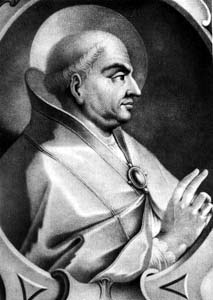
Tales From the Papal Crypt: Pope Martin, Enemy of the State


Pope Martin I

"The police would not allow the holy man to land, though he was suffering severe pain.  Instead they went ashore themselves and rested in comfort.  However, the priests of the locality and all the faithful sent gifts in no small quantity of things that might be useful to him.  But the police brutally tore these gifts from the people's hands in the presence of the Pope himself, cursing and swearing the while.  Anyone who brought the Pope small gifts was chased away after being insulted and beaten, with the warning:
'Whoever wishes well to this man is an enemy of the state.'"

-eyewitness account by a companion of Pope Martin I

To begin our tale, let us first proceed to its ending.  In AD 655, somewhere in a little, isolated town on the edge of the Crimean Sea, Pope Martin died.  The exact cause of his death is not known; based on the available evidence, he was suffering at the least from chronic malnutrition, physical and psychological abuse, conditions of extreme cold and privation, and many untreated medical ailments.  Most likely, his death did not cause much of a stir for either the Imperial officials set to watch him or the local townspeople; after all, his death had been the general idea of sending him into exile there in the first place.  The town of Cherson was well used to hosting political prisoners, and the Imperial police well used to hastening their deaths.

Yet there is a good reason to begin at the end with Pope Martin; for his death is, at least statistically, the most notable thing about him.  Pope Martin is the last Pope to this day to be venerated as a martyr by the Catholic Church.  Popes since then have died in office, and some have even been murdered; but Martin is the last who is considered to have been killed in odium fidei--that is, in hatred of the Catholic Faith, the Church, and Christ himself.  This is no small accolade.

The first Pope to be martyred, was, of course, St. Peter himself--and the last is St. Martin.  No small accomplishment, that.


Wednesday, May 29, 2013

Tales From the Papal Crypt: Introduction


The Papacy is pretty cool.  It also happens to be one of the oldest continuous institutions in Western Civilization.  There has been a Bishop at Rome for about 2000 years, give or take a century or so.  To compare, there has been a President in Washington, DC for a little over 200 years, a King in England for about a thousand, and when the office was dissolved in 1924, there had been a Caliph ruling over Islamic civilization for less than 1300 years.

Like any other old institution, however, the Papacy has not always been as it is now.  It has had its ups and downs, its triumphs and its disasters, its disgraces and its vindications.  It has gone through many metamorphoses in response to the needs and conditions of the times, and its practical role in the world has varied a great deal over the centuries.  Yet the continuity at the heart of the Papacy has been singular, indeed.

And what a history it has been!  The Papacy has been at the heart of so many major historical events that it is almost impossible to recount them at all.  The amount of adventures, intrigues, battles, arguments, tragedies, and victories in which the Papacy has played its part in is enormous, and enough for many a good story.  Thus, for your edification and entertainment, dear hypothetical reader, I thought I would take the time to tell a few of these tales.  They will be told in no particular order, neither chronological nor thematic, and most of them will not be told at all.  But still!  If you're interested in learning more about the Papacy in history, read on!

Wednesday, August 22, 2012

The Ecclesiology of the First Century Church: An Exercise in Hopefully Plausible Speculation

Disclaimer: This post is really long.  Like really, really long.  If you're gonna read the whole thing, you might want to get yourself something to drink, or perhaps a healthy snack, first.  Like maybe a grapefruit?  Grapefruit is pretty cool, you know.  

Got it? Then read on!

Ecclesiology, for the unaware, is a word for the structure of a Church or other religious body.  Now, while I'm sure you've all been hoping for an exciting examination of the structure of 1st century Persian Manicheanism in comparison to the Manichean church of the 4th century, I will instead (surprise!) be examining the ecclesiology of a more obscure religion called...(now where did I put that slip of paper?)...ahem..."Christianity."  Perhaps you've heard of it?

Apparently, Christianity is a pretty big deal.  Who knew?

I've been thinking about this topic quite a lot lately, and I have thought of it quite a lot more over the course of my lifetime; this post is essentially me trying to work out and fit together the various thoughts and ideas I've had on this topic in a way that halfway makes sense.  It will be mostly speculation, and, while I will make references to sources where appropriate, this is not a real work of scholarship with citations and such--that, if it comes, will be another project.  What this is is essentially what I've come to think and speculate after reading many of these sources and trying my best to understand and synthesize them.

Now, the Great Question of 1st century Christian ecclesiology, whether you're a Protestant, a Catholic, or a Whatever, is, essentially, "How do we get from Paul to Ignatius?"
St. Paul thinks
That is, the Apostle Paul's writings (which you can find in the New Testament) are pretty much THE source we have as to the day-to-day workings of the various Christian churches circa 50-60 AD, and from them, people have developed all kinds of theories about how things worked; these are supplemented by information we get from the Didache (a 1st century catechitical text) and the other books of the New Testament.  While I'll go over it in more detail later, the long and the short of it is that the Pauline letters show us a church structure with basically two levels of organization: the local one, composed of officials known indifferently as "presbyters" (elders) and "episkopoi" (overseers) and inferior officials known as deacons; and the super-local one, composed of inferior officials known as "prophets" and "teachers," and superior officials known as "Apostles."
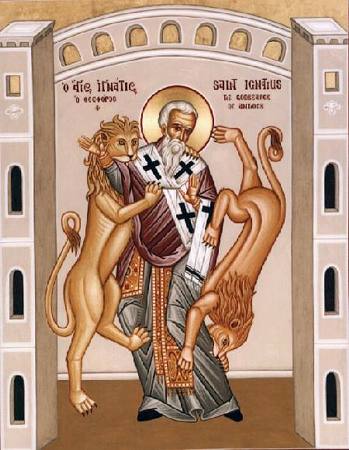
St. Ignatius plays with lions
However, if we jump about 50 years forward to the years at the very beginning of the 2nd century, shortly after the death of the last Apostle, we have seemingly a completely changed ecclesiastical structure, universal throughout the entire Church.  One of our earliest and best sources for the structure of the Church at this time is St. Ignatius of Antioch, a Bishop (hey, what's that? you may ask.  Well, that's kinda the point) of Antioch in Asia Minor, who at around the turn of the century was forcibly removed from his flock and taken to Rome to be fed to the lions.  Along the way to his destination, Ignatius wrote a series of letters to various prominent churches in the Roman world, presenting his final lessons on doctrine and practice while preparing to meet his Lord.  In this letter, Ignatius emphasizes one single thing over and over and over and over again, with as much emphasis as it is possible to give anything: the absolute centrality and necessity of communion with "the Bishop," the singular official presiding over almost every Church throughout the world.  The Bishop, Ignatius makes clear, is simply the fulcrum point on which the Church itself hangs; those who are in communion with the Bishop and obey his authority are within the visible bounds of the universal Church, and those who are not are heretics and schismatics.  And lest you think that this was simply Ignatius day-dreaming a little bit on the road, his letters (and the fact that they were preserved by the communities he sent them to) make it very clear that all the Churches he writes to already possessed just such a Bishop, who already made all these claims and was obeyed by the vast majority of the faithful.  Besides this, in every place to which Ignatius writes, there are also the two other groups of officials which we have already encountered, the presbyters and the deacons, whose role (according to Ignatius) is to assist the Bishop in carrying out the work of the Gospel.  Apostles, as we might expect, are looked back on as part of a past age.

So, looking at this development, one question should jump out at us almost immediately: Whence the Bishop?  Where did this Bishop guy come from, anyway, and why is he suddenly the boss?  Over the course of the years, scholars, theologians, and people in tutus have proposed any number of theories as to the origin of what is called the "monarchical episcopate" (or, put more simply, the Bishop being in charge), the most prominent of which are probably the theories of Apostolic Succession and Gradual Elevation.  The first theory is that the Bishops were appointed by the Apostles as their direct successors, to, essentially, fulfill their role in the community; the second is that the role of the Bishop developed gradually over time from within the ranks of the presbyterate, with one presbyter gradually becoming more and more prominent within the body until he came to be seen as an order existing above it.  We'll go over what I think of all this a bit later.

However, this is not the only major question of first-century ecclesiology.  Even if we leave aside the seemingly post-Biblical role of the Bishop, there's still the question of what, exactly, is meant by the terms presbyter, episkopos, apostolos, and diakonos, officials whose roles are all very much debated in scholarly and Christian circles.  This question is obviously one of great importance, as it has important implications for how we view the entire question of ministerial roles in Christianity, the priesthood of all believers, apostolic succession, etc.

Monday, August 13, 2012

Trioculus, Jaxxon, and Waru are Star Wars

Following from the incredible hypothetical success achieved by my "Morn is Star Trek" post, I have found myself frequently and hypothetically pestered by fans, compressed air machines, and other air-moving appliances, all buffeting me with the same question: "What about Star Wars?"

I admit that when I first hypothetically heard this question, I did not take it very seriously, and answered it with the famous, proverbially hypothetical reply: "Well, what about it?"

However, after thinking long and hard on the issue, I have come to the hypothetical conclusion that this answer is somewhat flippant, and that it behooves me to take the feelings of my hypothetical air-moving appliances more seriously than this.

So!  Here, my beloved compressed air machines, is my answer: I am a Star Wars fan because Trioculus, Jaxxon, and Waru are Star Wars.
Star Wars!

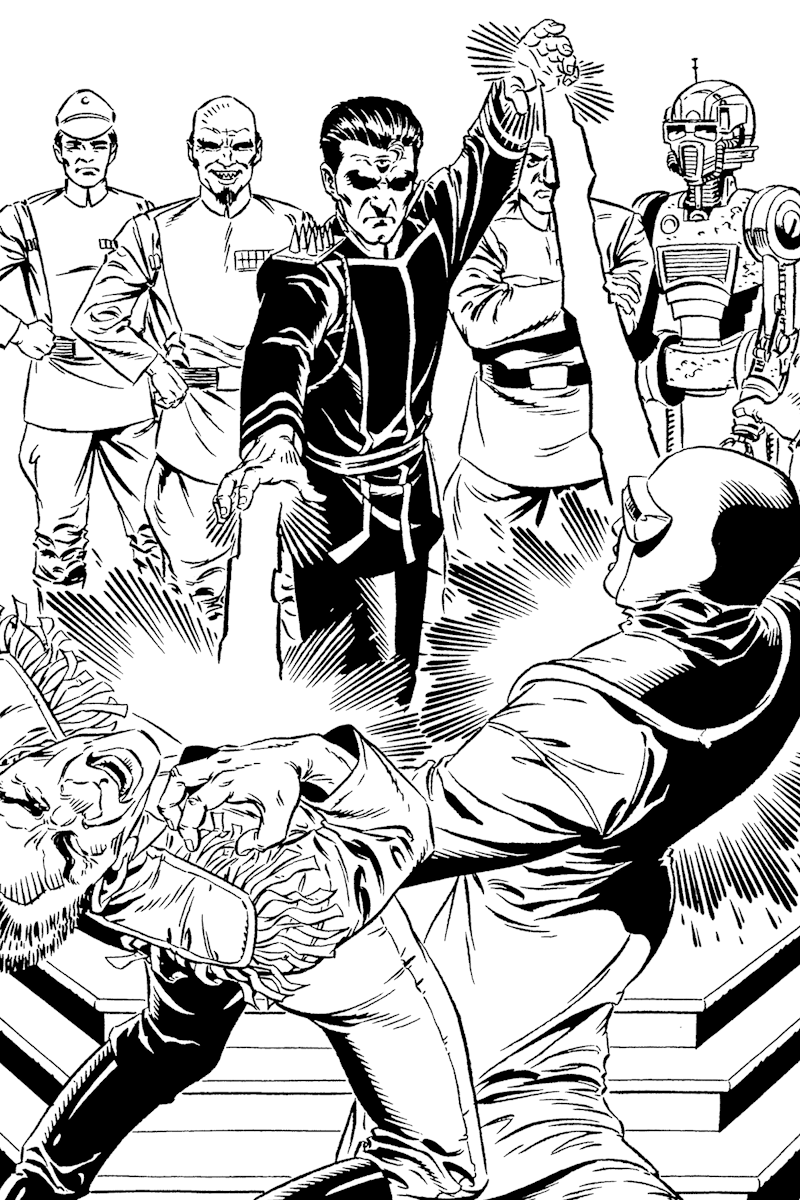
Allow me to clarify.  Now Star Wars is, as we all should know, The Space Opera of all Space Operas, the Space Serial of Space Serials, boldly charting the way out of the God-forsaken Seventies with the heart of a Flash Gordon serial, the head of Joseph Campbell, and the hind-quarters of Star Trek.  Many people have many reasons to love Star Wars, from love of sci-fi technology, naval tactics, and politics to love of operatic characterization to love of mythology to love of pop-culture philosophizing to love of Harrison Ford to love of Jar-Jar Binks.  All of these are perfectly legitimate reasons to be Star Wars fans--except for the last one-- and I wouldn't want to challenge any of you who hold to them.  But for myself, the main reason why I continue to enjoy and appreciate Star Wars is because nowhere else in fiction does the evil Emperor of the Galaxy have a secret three-eyed pacifist son who ends up getting impersonated by another three-eyed mutant who turned to evil after being teased as a child about his third eye.
Star Wars!
Also, nowhere else in fiction does a giant, carnivorous green bunny rabbit team up with a desperate group of smugglers and criminals to fight off a vicious swoop gang while constantly remonstrating about his dislike of Space Carrots.  
Star Wars!
And, of course, nowhere else in fiction is a noble, heroic Knight with telekinetic powers rendered helpless by the mere presence of a giant pile of orange goo with healing abilities.
Star Wars!

And yet...all of these things are Star Wars!  That is to say, all of them are "canon," all of them "really happened" in the exact same fictional universe in which Luke Skywalker blew up the Death Star, Han Solo was frozen in carbonite, and Jacen Solo was captured and tortured by extragalactic invaders.  All of these things, dark and happy, good and bad, serious and silly, philosophical and nonsensical, coexist in the same universe, the same setting, and sometimes even the same time.  At the same time as Emperor Palpatine is committing genocide against Alderaan, a giant green bunny is travelling around the underworld doing odd jobs and calling himself a "rocket rabbit."  At the same time as the Empire is struggling for its life in massive battles and campaigns throughout the Core, a three-eyed mutant is being proclaimed Emperor of the Galaxy and hunting desperately for the lost Glove of Darth Vader at the command of a dwarf dressed in a sparkly robe.  At the same time as the New Republic is dealing with political strife and resource problems, a gooey, extra-dimensional entity with anti-Force properties is creating an apocalyptic cult on a space station orbiting a crystal star.  

This, ultimately, is the real genius of Star Wars.  Don't get me wrong--the Star Wars films, especially the originals, were and are brilliant, and would be remembered and enjoyed by generations no matter what.  However, if that's all Star Wars was, and all Star Wars remained, we would not still be talking about it today, and I would not still be writing and thinking about it on a regular basis.  However, what makes Star Wars ultimately great is that the films are not all Star Wars is.  Star Wars, according to the official policy of Lucasfilm, is also innumerable books, comic books, and video games, all of which (with a few exceptions) are officially canon, and all of which really happened within the overarching universe of Star Wars.  That's what makes Star Wars great--what makes it not just a series of films, or a series of books, but in a sense a real universe, filled with many things silly and serious, grim and ridiculous, deep and shallow.  

Star Wars thus becomes far, far more than the mere "vision" of one man, and far more, indeed, than any one man's vision could ever hope to encompass.  

Of course, the various sources don't always play well together, often seem to contradict each other...but of course, these contradictions and various representations are always smoothed over and explained in the end.  Indeed, in this, Star Wars becomes even more like the real world--for what historical sources do we have which do not have seeming contradictions, strange points of view, and just plain oddities, which must be made sense of in the same manner? Likewise, this vastness of the universe provides so much room for cross-pollination, expansion, and continuing creative growth; a character, a species, a planet, a ship, can start off in one source by one author as a random mention with no explanation, then get a backstory in another work from another author's pen, and become the key to saving the Galaxy in a third.  Military campaigns and political events originally portrayed in a hundred unconnected sources can be brought together into a comprehensive, tantalizing picture of Galactic history and civilization, with room for debate and speculation to last a lifetime--a picture that is always being updated with information from new sources and stories.  Far from being "stifling," the vast continuity of Star Wars provides so much potential for stories and creativity that it's frankly insane--and the requirement of doing some research to keep from blatantly contradicting another source is no harder than searching Wookieepedia, and certainly far, far easier than writing any kind of historical novel.

Thus, ultimately, the Star Wars universe and setting becomes a place of almost infinite creativity and creative potential, with room for the both most serious hobbyist and the most unserious humorist.  

And that, my dear compressed air machine, is Star Wars.

Star Wars!


But, really, guys, now that all of that tom-foolery is out of the way, allow me to be serious for a moment.  
If you haven't understood the point of my post up until now, let me make it crystal clear for you: Waru is Star Wars.  You like Star Wars.  Therefore, you must worship Waru!  

C-3PO Loves Waru

Waru, you see, is an extra-dimensional entity with anti-Force properties and the ability to heal people by encasing them in his orange goo.  He created the Cult of Waru because he loves us and wants to devour our life-essences.  Though the evil Jedi and the evil Republic drove him from our dimension and dispersed his cult, nevertheless the loyal followers of Waru know that he shall one day return and fill the entire universe with his gooey orange majesty, punishing all those who opposed him and rewarding his loyal followers!  Join the Cult of Waru today!


Also, Trioculus is the rightful ruler of the Empire, and I highly recommend that you enlist in his forces immediately, lest he find you and punish you with his Lightning Power of the Dark Side.  The Eye of Trioculus is upon you, peon!  Dark Greetings!

Oh, and don't do Space Carrots, kids.  Seriously.

Thursday, June 21, 2012

Why are the Papists Aggrieved?

St. John Fisher, Aggrieved Papist

Tomorrow is the Feast Day of St. Thomas More and St. John Fisher, two English Catholic saints who were martyred rather than bow to the newly-founded State Church of Henry VIII.  By what is by no means a coincidence, today happens to be the beginning of the US Bishop's "Fortnight For Freedom" campaign, a two week period dedicated to prayer and demonstration against President Obama's "HHS mandate," which requires all Catholic and Christian institutions to provide free contraceptives and abortive drugs under the provision of healthcare.  I will be posting frequently about this over the next few weeks, to explain exactly how and why this is so objectionable, why it must be prevented, and why it demonstrates that President Obama should under no circumstances receive a second term of office.  For now, though, I will begin with some more general observations.

In these trying times, we see all around us many, many people both small and great who consider this entire campaign and this entire issue simply facetious, blown-up, and simply a big whopping deal about nothing.  To them, all the talk by the Bishops and by Catholics about "religious freedom" and about "religious beliefs" and "principles" is simply a pseudo-intellectual cover for the real reason why these people oppose the mandate: essentially, psychological and emotional hang-ups on the past, a fear of women and female sexuality, and an overwhelming and irrational desire to force women barefoot into the kitchen to make them sandwiches.  They honestly cannot see why in the universe Catholics will not simply get over their silly little hang-ups and rejoin the larger society, why they will not give up their emotional prejudices and acknowledge the great Principles of Sexual Freedom and Women's Rights--or at least, as the government generously allows them, simply practice their beliefs in private as much as they want, without trying to impose their prejudices on the rest of society or act as though they have any application to anyone besides themselves.  Really, Catholics have no reason to be upset at all.  Haven't we given them plenty of room, really more room than we should?  Certainly, the government finds it necessary to suppress some of their practices (like that of running hospitals and schools that don't give out contraception) that are dangerous to the health of society at large; but otherwise, they are and will be left in perfect peace, without disturbance.  What could Catholics possibly be aggrieved at?
Cardinal Dolan, Aggrieved Papist

The answer which you see more and more people coming to is simply that these people are really and truly dangerous and unreasonable, with a psychological need to impose their prejudices on everyone else, and that this entire affair is no more than a cloaked attempt to eliminate contraception from the entire nation, a War on Women.  Thus, the proper response to the Catholic campaign for "Religious Liberty" is to attempt to reasonably persuade everyone you can within the enemy camp how much it is their own interests to remain peaceable, and otherwise prepare one's defenses against the onslaught.

By what is simply a coincidence, yesterday I came across a book open on a table, and my eye was drawn to a quote from a man with very similar problems with the Catholics of his own day.  I will quote at length: