Showing posts with label Star Trek. Show all posts

Thursday, June 11, 2026

Three Lessons for Starfleet Academy

Star Trek has reached a crisis and juncture and turning point--which is not unusual.

If my very lengthy series of essays on this blog laying out (in rather inaccurate fashion) the history of Star Trek have anything to say, it is that Star Trek is not and never has been a simple, single formula or genre or thing or "vision" of Gene Roddenberry or anyone else. Most of what makes Star Trek interesting to me, in fact, is the intensely collaborative nature of the (now extinct) genre of network television, and how tied Star Trek has always been, not to any particularly original treatment of science fiction or politics, but rather with the ever-shifting personal and political and utopian visions of America looking at itself.

Anyway, more or less since the year 1966, Star Trek has been in crisis: beginning with the initial crisis of its failed first pilot, extending through the crisis of its too-expensive budget and too-low ratings, through the crisis of its first cancellation, through the crisis of its second cancellation, and ending with the crisis of its true and final cancellation after its third season. 

Then began the terrible monstrous crisis of trying to revive Star Trek, which took up most of the 1970s, got a lot of people fired, and resulted in dozens of unproduced scripts, lots of unused design work, one terrible cartoon show, and one terrible (but sublime) film. Then there was the terrible horrible crisis of TNG's birth and first two years, then the crisis of how to do a TNG spinoff in the '90s, and a lot of other crises that I refuse to summarize in this sentence.

Certainly Star Trek has been in crisis since the year 2005, when Star Trek Enterprise was unceremoniously cancelled after four seasons. There are a lot of things one could say about Enterprise--and maybe one day I'll say them--but perhaps the most relevant is that its demise is impossible to untangle from the gradual and now irreversible decline of network television, television networks, and indeed television itself. 

In 1995, Star Trek Voyager had debuted as the flagship show of the new network UPN; in 2001, Star Trek Enterprise took over that role; in 2005, Star Trek Enterprise ended; and in 2006 UPN itself went the way of the dodo. Its successor, the CW, has like most of network television continued to limp along til the present day, gradually losing viewership and profitability and shows: it now runs more or less exclusively sports, news, reality, and variety shows, with its last produced scripted drama show set to end this summer. 

A few years later, though, Star Trek took to the big screen, attempting to join the "Marvel rush" of would-be blockbuster films greenlit by executives desperate to find any even vaguely comic-book-esque franchise (Battleship? Emojis?) to share in the bounty: and, like most of their peers, met with mixed success. JJ Abrams' Star Trek produced three successful, popular films that nonetheless were considered disappointments by the studio for not matching the grosses or profit margins of true blockbusters: and Star Trek was once again left to die.

While all this was going on, a little website called Netflix was introducing on-demand streaming to the world: an event that not only accelerated the decline of network television, but also led to a desperate attempt by any and every studio to replicate Netflix's success. In 2014, CBS, the owner of the Star Trek shows, released CBS All Access (later Paramount Plus), a transparent desperate cash grab with a complete dearth of original content whose main selling point was that it had the old Star Trek shows available to watch. And so, a new era began, where the hoary network-television entity Star Trek would be retailored for a new age of free-flowing subscriber cash, maximal budgets, and an ever-increasing demand for content. 

And then, of course, the streaming economy completely collapsed, and studios began cutting back massively, cancelling and reducing budgets across the board in a desperate attempt to figure out how the new model of streaming television could possibly be profitable. 

Hence, the latest Star Trek show, Starfleet Academy was cancelled shortly after the airing of its first season ended, and probably more than a year before its already filmed second season was set to be released (the date has not yet been announced): as I write this, its sets are being auctioned off publicly for peanuts. Strange New Worlds, despite having two seasons left to air, has also already finished filming its fifth and final season: and for the first time since Star Trek Discovery began in 2017 there are no Star Trek productions filming anywhere in the world.

Meanwhile, Paramount is in the process of being bought out by Skydance, run by the son of Trump ally and CEO of massive-beneficiary-of-circular-AI-deals Oracle Larry Ellison in a monopolistic bargain that numerous Hollywood and Star Trek stars are currently protesting, but which many people on the Internet either hope or fear will make Star Trek stop being woke--reactions themselves occasioned by the massive, politicized online backlash to Starfleet Academy for being woke and/or having a gay Klingon. And as the Culture War (and also a real war) rages on, Star Trek fans around the world wait, and watch, and bemoan the fact that (undeniably) Star Trek is In Crisis, that (once again) Star Trek As We Know It Is Over, and wonder if anyone, anywhere can perhaps (in a stunningly original neologism that I just came up with) Make Star Trek Great Again.

As the dust settles, though, those of us not engaged in furious online debates over Wokeness (an online term for things that are cool from the year 2015) versus Anti-Wokeness (an online term for American conservatism from the year 2019) can once again take stock, reflect, and post absurdly long essays on Star Trek to our blogs. Or as Quark said, "the more things change, the more they stay the same."

Abstracting (quod sit impossibile) from the political and economic situation of America, the fact remains that a lot of people have not been particularly happy with the 2017-2025, streaming-bubble, Alex Kurtsman era of Star Trek. Some of those people have been merely grumpy old men who vastly prefer rewatching another episode of Star Trek TNG to watching any new show whatsoever or spending time with their wives; but some have been people who had legitimate issues with the actual creative quality of these shows. And what is more, this era of Star Trek, taken as a whole, has in fact resoundingly failed to recapture the general audience lost to Star Trek c. 2000, so that Star Trek is less culturally relevant in the year 2026 than it has ever been, even during the 2005-2009 interregnum, and is more or less the least culturally relevant franchise still producing content--significantly less relevant, alas, than The Fast and the Furious, whose proposed eleventh film is currently bogged down in production hell.

Hence, it is my goal in this post to Do My Duty as a Star Trek Fan (i.e. tedious old man) and do the hard work of drawing some lessons from the recently completed era of Star Trek to, hopefully, offer to future generations and/or future runners of the Star Trek franchise. Unfortunately, it is too late for the actual writers and producers of Starfleet Academy to benefit from them: but the below "lessons" are still offered in the somewhat aggressive, ironic, tongue-in-cheek spirit of one educator speaking to another. 

Star Trek has in its history been run by everyone from an ex-Southern-Baptist ex-cop (Gene Roddenberry) to a Jewish ex-Quiz-Kid (Harve Bennett) to a Jewish writer of Sherlock Holmes novels (Nicholas Meyer) to a Jewish actor-turned-director (Leonard Nimoy) to another Jewish actor-turned-failed-director (William Shatner) to a Jewish documentary producer (Rick Berman) to a Jewish writer with a blue beard and an obsession with Las Vegas (Ira Steven Behr) to a Jewish writer of Transformers films (Alex Kurtsman): and I for one am eagerly awaiting the next anointed one in this storied lineage.

For after all, when Woke and Anti-Woke both disappear into the mists, reality will remain: and so will things like aesthetics and framing and character and story and plot and themes and meaning and the true and the good and the beautiful. Also, just FYI, budgets really matter.

Thursday, June 13, 2024

Star Trek Discovery and the Unfathomable Profundity of Stupidity

Star Trek Discovery and the Unfathomable Profundity of Stupidity


"He's dead, Jim."

Star Trek: Discovery is over. Somehow, some way, it ended, lurched to a stop, was euthanized, put out of its misery, executed by firing squad, shot out of an airlock by a vengeful Admiral Adama, kicked over a cliff into erupting lava by Captain James T. Kirk of the Starship Enterprise. You pick your metaphor.

It seems, almost, beyond belief. How could Star Trek: Discovery end? 

A better question: how or when did Star Trek: Discovery begin? Did Star Trek: Discovery in fact take place? Jean Baudrillard, please answer your pager.

Here is a strong claim that I completely stand behind: watching Star Trek: Discovery for five (okay, four and a half) seasons has challenged me intellectually and personally as no other work of art has ever done before. It has tormented me, infuriated me, angered me, disgusted me, dispirited me, inspired me, filled me with joy and hatred and loathing and annoyance and, ultimately, love.

Let me start with a disclaimer. I am not someone who dislikes bad art; I am not someone who dislikes stupid art. I have long had a profound fondness for the unintentional humor and joyful creativity of many works of art that are, on the face of it, badly put together by artists in profoundly imperfect control of their artistic elements. 

Discovery is different, though.

To explain how, let me offer a strong claim: it is nearly impossible to comprehend Star Trek: Discovery as a work of art, the result of human intelligence and creativity and intentionality, at all. Star Trek: Discovery is not a substance, not even an artificial substance-by-analogy, the work of a demiurge human or divine. It is not an essence unfolding teleologically through time; it is not a story, a narrative with a beginning and an end; it is not even an event, an assemblage of elements held together by loose networks of simultaneity and cause-and-effect; it is not even  a Gnostic emanation, a failed attempt at conceptual realization birthing other abominations in turn. Star Trek: Discovery is, rather, most fittingly likened to the unintelligible forces of time and chance and matter themselves, contrary elements devouring one another in the dark, splitting and dividing without end in a chaos of Ovidian language, Plutarch's dark Typhon, Aristotle's potentiality awaiting act, the waters over which the spirit hovered before the beginning of creation.

It is, in other words, a really, really, really stupid television show.

As an obnoxious intellectual man, I have all my life believed strongly that intelligence--or rather, what intellectuals call intelligence, mental facility and speed in processing information and analysizing it and commenting on it and performing simple problem-solving tasks--is, in the grand scheme of things, not particularly important. Intellectuals are, by and large, self-deluding, self-aggrandizing bastards unable to see out of the boring detritus of their own minds and into the real world, even when it surrounds them and pounds them repeatedly into the metaphorical sand of reality like waves on a beach. In contrast, people colloquially described as stupid are usually prime exemplars of humanity, with their lack of internal preoccupations allowing them to simply accept and take stock of reality and respond to it in ways that are uniquely personal and so, by and large, both interesting and delightful, people adept at understanding and therefore intelligence in the true sense. In my experience, in this proper sense, stupid people are generally much more intelligent than smart people.

Nonetheless, stupidity is, as they say, said in many ways--and stupidity as a (relative) personal quality defined by intellectual receptivity and lack of speed in information-processing and verbal creation is quite distinct from stupidity in the sense of the total rational incoherency often found in intellectual objects and artifacts and beliefs. Human persons are always rational, even when they are unconscious, dreaming, or dead; receiving the world via the intellect is simply what they do. Concepts, ideas, and stories, however, are rational only by participation in human reason and its objects; and they can, to quite a large extent, fail to participate in that reason at all. Insofar as they fail to do so even minimally, they fail to exist.

Star Trek: Discovery is, in my limited experience, the work of art that most fails to participate in any form of human reason. Hence, it is, I would argue, impossible to analyze Star Trek: Discovery in any of the terms typically applied to human artifacts and narratives. 

Because of this, I aim to discuss Star Trek: Discovery not in terms of a unified work of art, a narrative, a set of characters, a plot, a set of themes. I will discuss it, rather, precisely in terms of stupidity, incoherence, and the roots of these stupidities and incoherences in the world around us--first in the stupid, incoherent shadow world of pop-cultural trends, then in the broader, incoherent world of American society itself, and finally in the real world as it actually exists. 

In the interests of fairness, it should be pointed out that Star Trek: Discovery's stupidity and incoherency is not, in fact, a bizarre, unique aberration in an otherwise pristine media landscape. In fact, the main note of popular culture in recent years has been precisely the same sense of fundamental incoherency found in a more extreme form in Discovery. Understanding where this incoherency comes from, is, I think, somewhat important for understanding where we are as a society, and for understanding how to prevent things from getting much, much worse.

For the very fact that Star Trek: Discovery exists at all, that it ever existed in even the most minimal sense, that it persisted, and that it ended tells us a great deal indeed about the world we live: and hopefully, what to do about it. 

To sum up Star Trek: Discovery, the stupidest work of art I have ever seen, I will make use of the stupidest format I know of. Here, then, in listicle format, proceeding from the most obvious to the most profound, are Ten Ways in Which Star Trek Discovery Illuminates the Profundity of Stupidity

Saturday, May 25, 2024

The Millennial Sovereign, The Real Story of Star Trek, and the Problem of Charisma

The Millennial Sovereign, the Real Story of Star Trek, and the Problem of Charisma

What is it that makes a human person more than just another human person?

This is a rather important question, to which many highly conflicting answers have been given. 

We are, most of us, surrounded by people day in and day out, both in person and through media and social and political structures. Most of these people we do not, really, know particularly well. Some of these people want things from us; from some we want things; and some of these people will not just want something from us: they will want us. So how do we decide, among all these people, who we will pay attention to or not pay attention to, trust or not trust, listen to or not listen to, obey or not obey? How do we decide who we give ourselves to, as friends, lovers, helpers, leaders, followers, servants? 

This is a crucial question when it comes to individual relationships and individual lives; but it is in many ways even more crucial when it comes to the lives and destinies of whole groups and peoples and nations and Empires. In our personal lives, we can (if we choose) exercise prudence and wisdom and take our time and think our way through who we trust and who we give to and who we give ourselves to. When it comes to the realms of public culture, political culture, especially mass-media culture, we frequently are under far more pressure, and have far less to go on. How do we decide who is telling the truth in a public war of words between two politicians or influencers or apologists or academics talking about something we know nothing about? How do we decide who to trust, to whom to give our money, our time, our attention, our vote, our obedience, our trust and love and devotion, when our choice actually matters, for ourselves and others?

There are many answers to this basic question, ranging from the rational to the romantic to the utterly insane. One common answer throughout history is charisma. 

Wednesday, May 10, 2023

Why Star Trek Generations is the Best Next Generation Movie: Or, Against the Art of Simulation

Why Star Trek Generations is the Best Next Generation Movie: Or, Against the Art of Simulation

Before I begin this week's post, I would like to offer a formal apology to my Dear Reader for the fact that, of late, this blog has been decidedly academicish in character, featuring posts on such topics as academic theology, theoretical physics, and even (alas alas) identity. To reclaim my status as a Man of the People, therefore, I have decided to return to the thing that this is blog is actually about: Star Trek.

(I have written about Star Trek a lot before, including a whole long series of posts. To find them all, click here.) 

However unfortunately I have to then immediately destroy all my cred as both a populist and a critic by engaging in a spirited praise of the most generally disliked of the Star Trek The Next Generation films: Star Trek Generations.

I will confess: I have always liked this movie, despite or because of its critical and fan shellacking. When I watched it as a kid, I liked it without any particular critical discomfort. As a Youth, beginning to be educated in the narratives and techniques of filmmaking, I came to recognize both the many technical flaws with the film, and the fact that in the Grand Myth of Star Trek it was seen as a Lesser Film, a disappointing murder of the great Kirk leading into the actually Great Film Star Trek First Contact. Now, as a man, I have come full circle to the deep, profound truth underlying my original uncritical liking of the film, and now see it, with deepened sight and far more wisdom, as the best of the TNG films. 

I was confirmed in this belief by a recent visit to my brother and sister-in-law, both of whom are visual artists who have made short films and who together run a glossy art magazine. Neither, it should be said, are Star Trek fans in any conventional sense. My brother grew up with it, but generally views most of the Canon with disdain; my sister-in-law has seen relatively little of it. They are also people who value very much the weird, the bizarre, and the original in art. And they both absolutely loved Star Trek Generations.

I was also spurred to write this by my recent experience watching the modern generations of Star Trek, and in particular Strange New Worlds S1 and Star Trek Picard S3, both of which could be quite fairly characterized as "nostalgia" or "fanservice art" and both of which have been highly praised by both fans and critics--certainly more than poor Star Trek Generations. And in comparing my reactions and thoughts in watching all of these examples in short succession, I began to come to some more general theses on contemporary popular entertainment and why it often leaves me cold.

After all, popular American art has by general agreement reached something of a nadir. The latest Marvel movies have been badly reviewed and disliked by fans; even the Mandalorian S3 has met with a similar reception; Sonic the Hedgehog 2 was a grave disappointment; and so on and so forth. And Star Trek Generations is, truly, a major turning point in the history of franchise filmmaking. The lessons allegedly learned from the critical and fan dislike of this film fundamentally defined all later Star Trek films, and through them franchise filmmaking at large. And those lessons, I firmly believe, were all wrong.

To anyone interested in any of the above, then, I present a series of theses on Why Star Trek Generations is the Best TNG Movie and What We Can Learn From It About How to do Popular Franchise Entertainment and Why A Lot of Recent Stuff Sucks.

Saturday, September 3, 2022

Mini-Art-Criticisms: Star Wars, Fellowship of the Ring, There Are Doors, Star Trek The Motion Picture

Mini-Art-Criticisms: Star Wars, Fellowship of the Ring, There Are Doors, Star Trek The Motion Picture

[I am experimenting with various formats in this column as I continue to be quite busy (and also because experimenting with various formats is what this column is all about). This week, I decided to collect some thoughts on a few books and films I have read/watched recently.]

In the last week or so, I have read the following books in their entirety, and watched the following films. The latter is a bit unusual, as I rarely watch films these days. Nonetheless, it occurred to me that they really dovetail in various ways quite nicely.

Tuesday, July 16, 2019

Star Trek Deep Space Nine: Or, There Are Weasels Under the Coffee Table: Or, Is 19th Century Liberal Imperialistic Utopianism Not All It's Cracked Up to Be?


Before I get finally and totally buried in the depths of the Dissertating Lifestyle, I present to you, my dear, long-suffering readers, the long-promised, oft-longed-for Deep Space Nine Mega-Post. This is my favorite of the Star Trek series, and so I have, as you might imagine, a fair bit to say.

Saturday, June 15, 2019

In Defense of the Awful, Terrible, No-Good Terrifying Alienated Surrealism of the First Two Seasons of Star Trek the Next Generation


Alright, stop the presses: I want to write something in defense of the first two seasons of TNG.

Now, before everyone stones me through the Internet (hundreds upon hundreds of virtual packets of communal sacred violence winging their way through the ether(net) to end the Contagion and reestablish order in society), allow me to explain exactly what I mean, and also what I don't mean.

Most notably, I do not mean that the first two season's of TNG (with the exception of a few episodes) are actually good seasons of television, let alone (Waru avertat) well-written seasons of television. For the most part, the dialogue is stilted, the characters unlikeable, the plots bizarre and frequently incoherent, and the overall setting stultifying to most ordinary forms of drama. On all these fronts, the later seasons of TNG are undoubtedly better.

Nevertheless, I have come to think that, when all is said and done, there is something to be said for the prevailing vibe, the portrait of a people and a universe, the cinematic and fictional and science-fictional qualities of Star Trek the Next Generation Seasons 1 and 2. Some of this even emerges out of the otherwise negative qualities of the show--and if I had to use a single word to name the elusive yet omnipresent value offered by these seasons, it would undoubtedly be "surrealism."

Star Trek the Next Generation Seasons 1 and (especially) 2 is, frequently, a glorious tour de force of surrealist entertainment, bordering frequently on horror.

Almost everything about the show, the characters, the plots, serves to reinforce this overriding sense of alienated surrealism 

Imagine: the human race, centuries in the future. A vast, powerful starship travelling through the blackness of space, crewed entirely by men and women in spandex jumpsuits and skirts who talk slowly and blankly and seem to be constantly concealing high levels of tension and mutual hostility. The society they live in, everything we see of it, is stamped with the same strange, sterile vacuousness that they themselves display, buttressed by a fanatical, ideological belief in its own absolute moral perfection.


Nevertheless, all is not well in paradise. All the sexuality displayed by the characters is marked by a bizarre combination of the weirdest kind of 1960s/70s liberationism combined with the weirdest kind of 1960s/70s sexism. Most of the character's backstories seem to feature some kind of tragic violence, especially death or estrangement from parents, as well as romantic relationship dysfunction. A number of the crew members seem to obviously dislike one another, but it can be difficult to pin down, because these dislikes are never expressed aloud, since all the characters interact, even when off-duty, with an odd sort of tense formality, like actors in a highschool production of Shakespeare. Perhaps this has something to do with the fact all of their emotions are being constantly monitored by the alien female psychiatrist in the skin-tight jumpsuit seated next to the Captain on the bridge. Her job, besides monitoring the psychological health of the crew, is to emote in an exaggeration fashion on behalf of the unfathomable the alien entities they encounter, breaking out into uncontrollable expressions of others' terror or horror, sadness or joy, as everyone else stands around and impassively watches her. For leisure, our heroes can make use of the perfect AI-created virtual-reality machine helpfully provided for their amusement, a machine that can display a perfect facsimile of any person or scenario and also has the power to create sentient life. They can also sit around their quarters alone and listen to classical music.

These bizarre people, in this bizarre society, are travelling through space into the unknown. This unknown, it seems, largely consists of unfathomably-powerful superbeings bent on judging or controlling or testing the human race, or at least our heroes. Each one of these superbeings, who have no obvious relationship with one another or any larger cosmic order, has the power to bend the very fabric of reality and accomplish incredible feats--and their own nature, purposes, etc, are rarely if ever clear. One of these intelligences puts the human species on trial to prove its worth, one just experiments on them like rats in a maze, one underwrites the arbitrary laws of a hedonistic society, one constructs a perfect artificial environment based on terrible 20th century pulp novel. Their power and purposes are, for the most part, equally unfathomable.


What the hell even is this? Well, for the most part, it's the result of the combination of a number of behind-the-scenes things that didn't work out very well. For Gene Roddenberry, Star Trek was an aspirational fable about a perfect evolved human race proving itself worthy at last, reaching ever-higher levels of existence through technology and scientific exploration, while giving a middle-finger to God and all other judgmental superbeings along the way. This didn't work out very well, though, and no one in particular could make sense of it or turn it into drama, so over time a succession of writers did their best to work with this idea, coming up with any number of one-shot high-concept science fiction storylines. The most competent of these by far was Maurice Hurley, whose fingerprints are all over the second season in particular. What he realized more than just about anyone else was that the Enterprise characters, as mostly blank ciphers of power and knowledge and perfection, really worked best (or at least most dramatically) when their power was challenged by superior power, their knowledge was stretched past its limits, their perfection revealed as a sham. So he wrote a number of stories where just this happens; a superior power acts, and our heroes do not understand how or why, nor can they do anything to overcome it: all they can do is escape or submit, and so survive, for a while. 


"Time Squared," perhaps my favorite of the bunch, is essentially a horror story. There is a power, an intelligence, that appears out of nowhere to threaten the Enterprise with destruction: but our heroes never make any sense out of it, what it is, why it's doing what it's doing, or how they can relate to it. Captain Picard, our arbiter of normal reality, is confronted with another version of himself, seemingly thrown six hours back in time, where he lies on his back, unable to focus on the world around him, but screaming in helpless terror, sure only of the need to repeat the cyclical events that brought him here. Picard, our Picard, is terrified: and in a key scene, he admits that despite all evidence, he recognizes nothing of himself in the person he sees. As if to underscore this, in the plot's pivotal moment, he shoots and kills his future self, then pushes the Enterprise to take a seemingly senseless action--and it works. They are all alive, free: for now, until the another inscrutable higher power makes them the object of its attention. 


"Where Silence Has Lease" is perhaps the most outwardly nasty of the episodes in the first two seasons: a horror story where our heroes are trapped in a starless void by a sinister intelligence who experiments on them like lab rats. In one such "experiment," an illusionary version of the Enterprise appears, that when beamed over to is all fun-house mirrors and illusions: our heroes exit one bridge directly onto another, looking through a door and seeing themselves from behind. Then an Enterprise crewmember dies in screaming agony, curled in a fetal position with his eyes wide and staring. Finally, the intelligence listens to Picard explain the mystery of death to two blank, illusionary versions of Data and Troi (the two strange, alien characters of the crew), and releases them again. Victory--of a sort.

 It is not just our heroes who are vulnerable to the terrifying powers of the universe, however, but their whole (supposedly superior) society. In "Conspiracy," the whole structure of the utopian Federation is infiltrated and taken over, without a shot being fired, by fathomless alien parasites who cannot be understood, cannot be negotiated with, but can only be defeated with brutal violence. The Federation is saved, for the moment. Still, they (and things much worse) are out there, waiting. 


The best of these episodes, and in a sense the climax of the whole theme,  is "Q Who?," Maurice Hurley's tour de force, which introduces the Borg, and makes the point emphatically that the Enterprise crew's ideological insistence on their own evolved perfection is a hollow sham in the face of a universe full of deadly powers they can neither control nor understand. It is, again, essentially a horror story. Q, the infinitely-powerful, mocking, judgmental superbeing, says the Enterprise crew are weak and arrogant, and cannot understand or control the universe as it is; and then he proves the point. Picard must beg, literally on bended knee for the help of this, mocking and judgmental but at least interested and sympathetic, superbeing against the fathomless, mindless power of the Borg. Their friendly superbeing has saved the day for them--this time. But the Borg are coming. 


These are (most of) the good versions of this story. There are bad versions as well, mostly (but not always) where Gene Roddenberry himself is calling the shots. "Royale," which has an interesting premise (fathomless superbeings kidnap a crew of astronauts, accidentally kill most of them, and then create an entire illusionary world based on a shitty novel for the one survivor to live out his life in misery), but which is otherwise a badly-paced mess; "Justice," where a race of child-like hedonistic sex-fiends turns out to be protected by an unfathomably powerful machine-god that nonetheless responds submissively to a moralistic lecture by Jean-Luc Picard;"Hide and Q," where Q is defeated and humiliated by yet another moralistic lecture on the perfection of humanity by the aforementioned Jean-Luc Picard; "The Last Outpost," where an ancient superbeing judges Riker worthy after he recites a line from Sun Tzu; et cetera. 


The benefit of this when it works, though, and even often when it doesn't, is that the strangeness, the surreality, never quite leaves you--and many aspects that might otherwise be considered straight-up "bad" can and do aid in that effect. The characters are written badly, taking on contradictory traits, likes, and dislikes, episode to episode and scene to scene, speaking and reacting in ways that no recognizable human person would do: but then, that helps with the sense of unreality, the sense that these are not human beings, not as we know them. Obvious conflicts among characters exist, but seem to have been deliberately edited out (as they often literally were by Gene Roddenberry's rewriting), or else resolved in the strangest possible ways: but we can treat this, too, as a sign of the dysfunction and alienation of a future society. Episodes are often heavily padded and paced glacially--there are shots featuring Captain Picard sitting on the bridge staring off into space and doing nothing; when an action is suggested, it is discussed in much more detail than is necessary; we watch in real time as mundane technological tasks are carried out; et cetera. But this, in a sense, is helpful; we can watch the unreality and strangeness of these characters and their world play out, and have time to focus on it, not merely on the shiny colorful plots and their supposed sense of excitement.

Whatever sense of the world, of Star Trek, we get from these seasons is quite far away from the bright, colorful character action-adventure of the contemporaneous original-cast Star Trek film series; and even from the pulpier, weirder world of TOS (which had its own share of superbeings). This is, genetically and dramatically, an idea of Star Trek that sits the closest, perhaps, to that of Star Trek the Motion Picture: an evolved humanity, composed of blank, unpleasant careerists, makes surreal, trippy contact with beings yet farther along the terrifying path of evolution, with vast intelligence and unfathomable power. A step beyond, and this is an idea of science fiction drawn in large part from 2001: A Space Odyssey, Stanley Kubrick's distancing parable about contemptibly small and petty evolved apes forcibly transformed by an unfathomable alien intelligence toward an isolated, distanced transcendence. Beyond that, in turn, this vision of Star Trek stands a lot more closely to the world of '60s and '70s sci-fi, The Twilight Zone, Gene Wolfe, Ray Bradbury, Arthur C. Clarke: stories about ideas, about the alienation of man in technological society, very often edging into outright horror.

And isn't there something about all this quite a bit more relevant, in our particular alienated, technological society, than the warm family and political drama of later TNG? The late-TNG and beyond Federation may be less of a utopia, but it is undoubtedly a much nicer place. In DS9, we eventually find, genetic engineering and experimentation is strictly banned--but in TNG Season 2, the Federation itself is carrying on such experiments, and accidentally creating deadly plagues in the bargain; and there is talk of conspiracy at the highest levels of Starfleet...


Later TNG largely replaced all this with stories about recognizably human characters existing in community, and then about politics and drama on a more human scale: cold wars and civil wars and family feuds and coups. This was executed a lot better than anything in the first two seasons of TNG, was a lot more interesting and thought-provoking and even meaningful, most of the time. Because of this it's easy to see the first two seasons as little more than an embryonic version of what was to come, picking out the elements that are the same rather than focusing on the differences--or just dismissing these two seasons altogether. The point of this blog post, though, is that it's worthwhile, also, to acknowledge that if a lot was gained, still something was lost in that transition as well. The first and even more so the second season of TNG were in many ways a recipe for a totally different show, a totally different vision of science fiction in general and Star Trek in particular. A better one? No. But one with an attraction all its own.

So: even if we (reasonably) decide to skip right over the first two seasons of TNG, let's acknowledge, for just a moment, the true surreality, the alienation, the horror, presented all too often in these episodes. Sometimes it is merely laughable, shoddy, obviously fake--but every once in a while, it becomes something more: genuinely disturbing. 


Anxious men in purple spandex sit alone in their padded rooms listening to Mozart, while outside in the darkness and silence limitless intelligences do unimaginable things for reasons no one can fathom--and watch, and judge.

Who can say why anything happens in such a world? Who can say what it means to be a human being in such a society? Causation has broken down, as have ordinary ideas of character and personhood. All there is to do is keep watching the alienated technological patients continuing to travel space, continuing to (hopefully) survive each encounter with their terrifying alienated universe.

Caveat spectator.

Note: if this interests you, I wrote a much longer & more comprehensive piece on TNG a few years ago which can be found here, as well as a shorter piece reviewing a few random episodes here

Friday, November 16, 2018

Pakleds and Klingons and Riker Rapidly Losing His Mind, Oh My!

So once again, after many years (months? minutes? I dunno, folks, I'm bad at math), the much-heralded, much-longed-for return of the Nathan Israel Smolin/Captain Peabody Star Trek Oral(?) History Blog Post Series Extravaganza! 

Continuing where we left off, here are a few mini-reviews of episodes of Star Trek the Next Generation. As with my TOS reviews, the idea is to skip over the most famous ("Best Of") the series, and instead highlight a few episodes that are not on any big lists, but which showcase aspects of the series as a whole, its strengths and weaknesses and special qualities. So without further ado, let's begin with one of those Weaknesses I just mentioned.

Wednesday, January 24, 2018

Star Trek as Imperialist Literature

I've watched and read and thought about Star Trek a lot more than is probably healthy, but here's something that only very recently occurred to me, at least in an explicit form.

Star Trek, of course, has its origins in the art and literature of Imperialism, in the first place from the naval and colonial literature of the British Empire ("a tall ship and a star to steer her by"), in the second place from Westerns and other literature of the Age of Westward Expansion and Manifest Destiny, and in the third place from Cold War, Kennedy-era art about superpowers and proxy wars. Yet I hadn't noticed that even in in-universe terms, there are literally NO non-Imperialist powers, and virtually no non-Imperialist entities, in the Star Trek universe. That is, there are no governmental entities that are not aimed essentially at unlimited expansion, or could not expand without limit.

The majority of both the villains and the allies of the Star Trek universe are single-species Empires whose raison d'etre is unlimited colonization and conquest by this single species over vast swathes of space and other species: hence the Klingon Empire, the Romulan Empire, the Cardassian Union, etc. This much is obvious.

What is less so is that the Federation is also a specifically Imperialist state, only one based on equality and liberal democracy and the extension of these principles. As the various series make clear, the Federation is constantly engaged in expansion, through exploration, colonization, and the frequent induction of new member planets. "First contact" with other species is carried out with the intention of eventually making them part of the Federation; and in many episodes we see new planets in the process of being absorbed into the Federation, with Bajor in Deep Space Nine only the most prominent example. The Prime Directive and the general Federation refusal to engage in wars of conquest is, at least in theory, a limitation on this--but in practice, it hardly seems to prevent or even slow down Federation expansion. A number of wars in the Star Trek universe, for instance, seem to have originated in the encroachment of new Federation colonies on the borders of other powers.

The United Federation of Planets is, in design, a version of the United States of America (down to the "Federation Constitution" with its "Guarantees" a la the Bill of Rights and its strict egalitarian policies banning caste systems and other non-egalitarian social structures in member worlds)--but it is a vision of the USA during its period of Manifest Destiny, that is, as a constantly expanding Imperialist entity aimed at a constantly-expanding "frontier." There is no inherent limitation to this expansion at all (such as a Galactic UN or any kind of necessary tie to a particular territory or culture), and no larger whole that the Federation considers itself subject to; in the long run, there is no reason besides force of arms and diplomatic policy why it would not absorb the Klingons, the Romulans, and every one of its rivals. In fact, if there's an underlying progressive arc to be discerned in the history of the Star Trek universe, its telos would seem to be the entire Galaxy (and beyond) as part of the Federation.

In the long run, as all the Star Trek shows make clear, the Federation, with its egalitarian policies and purported policy of non-interference, is simply far more effective and successful at Imperialism than any of its rivals. The Klingons, after all, no matter how much territory they may conquer, are still all finally bound to their sacred homeworld of Qu'on'os and the particular traditions and culture and religion of their species--and all these things are, in the end, limitations to the indefinite extension of their political power. The Federation, though, has no such equivalents.

There are apparently independent planets in the Galaxy, to be sure, though they get relatively little attention. Most of them are clear targets of the Federation's expansion, future member worlds to be enticed with economic and cultural and military benefits. A few are "neutral worlds" that exist on the margins of larger powers and generally are portrayed as havens for crime and the like. But even most of the "independent nations" we see are also expansionist Empires of various sorts. DS9's Dominion is a multi-species Imperialist federation with unlimited expansion as its goal. The Ferengi are an example of economic Imperialism, their goal unlimited business expansion and exploitation of resources. The Orion Syndicate is an expansionist organized crime group founded by a single species but incorporating many and operating within the network of Imperialist powers that dominate the Galaxy. The Borg, of course, are the ultimate "absorbers" and "assimilators" of species and people. And so on and so forth.

The Star Trek Galaxy, then, is dominated by dueling Imperialist expansionist powers, and everyone else has to find their place in the margins. Independence is, seemingly, scarcely an option--in Deep Space Nine, Bajor really has little choice but to join up with the Federation, since independence (as many episodes make clear) would immediately lead to annexation by a far less attractive Imperialist power (the Cardassian Empire). The Federation would not (and did not before) protect an independent Bajor--the price of safety is assimilation. The formation of any larger institution or whole over and beyond the Federation and its rivals is never even contemplated.

This is a dynamic that, to its credit, Deep Space Nine seems to get, and plays with a lot. The best example is in the speech I've posted here (which is a slight spoiler), as well as in the various non-Federation characters we see.

The normal critique of the Federation you tend to see is that it is economically Communist or really deep down violent and repressive (a la DS9's Section 31) or even just human-dominated and speciesist (a la Star Trek VI). I don't think any of these things are necessarily true--the Federation as portrayed in the various series and movies is clearly very committed to its egalitarian principles and codes of individual rights and principles of tolerance and multi-species cooperation and its very liberal-contractual theory of non-interference. But is the Federation intrinsically and by definition Imperialist? Yes, yes, yes, yes, and yes. There's really no question.

Wednesday, December 21, 2016

Attack of William Shatner, A Vulcan Televangelist, and Christopher Plummer With An Eyepatch; or, Farewell to TOS

The year was 1989, and Star Trek: the Next Generation was finishing its second dismal season.  The new spinoff, born of the unprecedented success of Star Trek IV: the Voyage Home (aka "the one with the whales") three years before, was now foundering in deep waters.  The new cast, crew, and setting, hampered by behind-the-scenes stress and Gene Roddenberry's titanic ego, had resoundingly failed to catch on with the general public, even as Trek fans continued to watch and wince.  In the summer of 1989, these loyal fans were dealt their worst blow yet: for positioned in the coveted season finale slot, the culmination of two years worth of storytelling, was Shades of Gray, a budget-saving clip-show in which an unconscious Riker is forced by an alien parasite to relive scenes from the first two seasons of The Next Generation.  Star Trek had officially hit rock bottom.

For watchers both devoted and cynical, there was, really, only one conclusion to be drawn: the attempt to recreate the success of the original Star Trek from the ground up, without the original cast and crew, was clearly a failure.

On the other hand, fans and critics alike were no doubt delighted to learn that, for all the failure and misery of Star Trek on television, Star Trek the film franchise was poised to continue.  The original cast and crew, beloved icons of American popular culture, with nearly a half-century of unprecedented success behind them, were once again poised to storm American cineplexes.  On June 9th, 1989, while the TNG creative team were desperately bailing water out of their sinking ship and trying to find someone--anyone--to steer it, the time-tested cast and creative team of the Star Trek film franchise launched proudly out of the harbor, headed for glory once again.

And promptly sank like a stone.

Saturday, August 6, 2016

The Next Generation of Television; or, It's Tough Being the Bastard Child of a Legend; or, How Gene Roddenberry Destroyed Star Trek; or, How Michael Piller Saved Star Trek; or, One Big, Happy Family; or, Meat Loaf and Mashed Potatoes


When last we encountered the intrepid hero of our articles--the mythic property "Star Trek"--he found himself at last in a truly enviable position.  Having braved the dangerous world of big-screen cinema, he had carved out a place for himself as a fun, character-driven franchise for the 1980s.  Star Trek IV, to no one's real surprise, was an absolute mega-hit, reaching an unprecedented audience of ordinary, movie-going Americans and thoroughly delighting them with its clever character comedy about a crew of misfits and their adventures in the contemporary world.  This was a film that anyone--emphasis anyone--could understand and enjoy, from the most fervent Trekkie to the most hardened Queen fan.  Star Trek was now an indelible part of the cultural mainstream--and it was also on a roll.

Faced with such unprecedented success, the studio rubbed its metaphorical hands together, and contemplated what to do next.  That there would be yet another big-screen Star Trek adventure was all but a given--and in a future post, we will consider that film and its sequel in turn--but Star Trek now was so popular that executives began to wonder if its audiences could not, perhaps, handle even more Star Trek than this.  Perhaps it was time to diversify the franchise, and take it back to its roots.

Star Trek was going to return to television.

There was, however, one big problem with this: or rather, a whole set of cascading problems, all leading to one extremely unpleasant conclusion.  First and foremost, the cast and crew of Star Trek, now much older and much richer, were not at all willing to return to the back-breaking 14-hour days of television, nor did the studio have any intentions of not making more films in order to let them do so.  If Star Trek was going to return to television, then, it would have to be on the basis of an entirely new cast, and thus probably an entirely new crew and setting.  This, however, presented its own set of problems; for Star Trek the film series had, over time, come to rely almost entirely on the strength of these original characters and their associated actors.  Star Trek IV had been a character comedy; and what it showed was that Kirk, Spock, and company were now so iconic and so beloved that they could be plunked down in 1980s San Francisco and still hold audiences riveted.  Casting a new crew, with new characters and new actors, would be a massively difficult undertaking, and would face significant opposition, not only from the hardcore fans for whom the original cast were gods of a sort, but also from the public at large, for whom Star Trek had become indelibly linked with these particular names and faces.  Even if this problem were overcome, any revival of Star Trek would also face an extraordinary, uphill battle in establishing itself as a television show; for by the 1980s, science fiction was, once again, basically extinct on television--meaning that any new Star Trek show would have to rely largely on the large and growing Star Trek fanbase, and not the general television-watching public, for its success.  This, though, presented its own problems; for the original show's fervent fanbase had watched and rewatched and scrutinized the original 79 hours of TOS so many times, and with such devotion, that virtually every deviance from the original would be noticed and criticized.

Hence, the studio quickly concluded, any new Star Trek show would have to possess some utterly undeniable imprimatur of true Star Trekness--something that would ensure that both the general public and the most hardcore fan alike would accept it, not just as a random sci-fi or drama show, to be judged on its own terms, but as Star Trek.

Faced with this dilemma, the studio, finally, was brought to take a very difficult and very dangerous, step; they went to Gene Roddenberry, and asked him to make the show for them.

Saturday, July 16, 2016

Spock Returns and Goes to San Francisco: or, How Star Trek Became A Franchise


The year was 1982, and Star Trek was back with a vengeance.

Star Trek II: The Wrath of Kahn, despite being made on the cheap in a very short amount of time, had come out to rave reviews and the highest box office numbers ever.  In the world of American popular entertainment, Star Trek had officially arrived.  No longer was this odd little space property from the '60s to be the butt of jokes, tarred with its cheesy acting and the obsessiveness of its fans.  Star Trek had entered the ring of cinema--the epicenter of the mainstream, the home of the culturally respected and esteemed--and made a name for itself there.  Star Trek belonged.

More to the point, for the studio at least, Star Trek II was quite simply a success, financial and critical.  It was the kind of film every studio executive wanted to be responsible for: a hit.

Still, the studios, and Harve Bennett, were not yet satisfied.

Sunday, July 10, 2016

The Wrath of Khan, the Recreation of Star Trek, and the Redemption of Kirk

If there's one key insight that animates the Wrath of Khan, fueling its action and driving its plot, it is this: Kirk is not a very good person.

Yes, Kirk, the heroic exemplar of Kennedy-era masculinity, Horatio Hornblower for the Space Age Gene Roddenberry's fantasy of an ideal military commander, is, in truth, a shallow, irresponsible man, egotistically obsessed with winning at all costs, who has spent his life flitting from one easy success to another without ever dealing with the consequences of his actions, his human limitations and flaws, and his own mortality.

This may seem harsh and one-sided; and indeed, Kirk is without a doubt the hero of The Wrath of Kahn.  But if this central point is not grasped, in all its starkness, then it will be completely impossible to understand what makes TWOK tick: and, more than this, what makes The Wrath of Kahn without a doubt the greatest of all Star Trek films, and, in my humble opinion, one of the greatest works of American cinema as well.

Where does this insight come from?  Well, to really understand that, we will have to go back in time just a bit, to explain the origins of TWOK as a film, and to tease out a number of other insights that ultimately paved the way for this one.

Sunday, July 3, 2016

The Death and Highly Improbable Posthumous Success of Some Show From the '60s; or, Almost Everything Was Terrible in the '70s; or, The Messiest, Bloodiest Television Revival Ever; or, Why Star Trek the Motion Picture Is Not Very Good


Famously, Star Trek went off the air, finally and for good, only a matter of weeks before the Apollo moon-landing.  Later, people involved with Star Trek would wonder what might have been if this momentous event had happened earlier: would the reality of outer-space travel, beamed live to televisions across the nation, have given the nation's top dramatic space show a new lease on life?

Well, maybe.  But if so, it probably would have doomed Star Trek forever.

Getting cancelled, it turns out, was probably the best thing that ever happened to Star Trek.  If Star Trek had run for a few more years, winding down in the manner typical of a reasonably popular television show, it almost certainly would not have become a phenomenon at all, and we probably wouldn't remember it at all today: not any more than we remember Wagon Train, the popular, long-running show Star Trek was based on.

Why was Star Trek cancelled?  Well, really, the question is why it wasn't cancelled before.  CBS had in fact planned to cancel it both after its first year AND after its second year; both times, the show was belatedly saved by a letter-writing campaign, the first led by a number of respected science fiction authors, the second by a few ordinary fans, the legendary Trimbles.  Why the studio wanted to cancel it is a bit more complicated; but it mostly came down to the fact that Star Trek was very expensive and not quite popular enough to justify itself in the network's eyes.  According to some, Star Trek was, in fact, very popular with the "youth" demographic especially coveted by advertisers, which means that in this day and age it would probably have stayed on the air a good deal longer; but Star Trek came before networks had begun to think in this way.  Judged on an absolute scale, it simply wasn't popular enough for CBS and Desilu to continue underwriting its exorbitant budget.

And by the end of its third season, Star Trek was tired.  Gene Roddenberry, its creator, had already jumped ship for easier and more profitable pastures; and despite managing to pull together a decent season, Star Trek seemed to be feeling its age.  Death was, to a degree, a welcome respite.

This was bad news for a lot of people, though, including the many who had drawn their paychecks from the show; but it was especially bad news for William Shatner.  Having just gone through a costly divorce, he found himself completely insolvent, forced to travel the country with a theater troupe, a dog, and pickup truck, living out of a camper because he couldn't afford to pay hotel bills.  Eventually, by taking every single role available to him, he was able to get back on his feet in time for Star Trek's eventual revival.  Leonard Nimoy did much better; he continued to work on television and theater in various high-profile roles, including on Mission Impossible and as Sherlock Holmes.  Deforest Kelley took a supporting role in one of the greatest worst films of all time, Night of the Lepus, about giant, mutant killer bunnies with a taste for human flesh (I highly recommend it), and then retired to his house and wife.

Life, it turns out, goes on.

Wednesday, June 29, 2016

A Computer, a Space Hippy, and the Ubermensch Walk Into A Bar

Following on my previous analysis of Star Trek TOS as a whole, here, taken pretty much at random (based, that is, on my own personal likes, dislikes, and fascinations) are discussions of three individual episodes of Star Trek TOS.


Where No Man Has Gone Before

This episode has a very special place in Star Trek history; it was the episode that convinced CBS that Star Trek could work as a network television show.  The network had been naturally impressed by Star Trek's concept, which promised a relatively simple and potentially lucrative way to do science fiction on television; however, it was ultimately disappointed by the first pilot produced, the "Cage."  Led by Jeffrey Hunter as Captain Christopher Pike, and featuring large-headed alien zoo-keepers with the power of illusion, the network felt that the show was, in a quote that has since become legend, "too cerebral."  Really, they were basically right; the Cage, for all the bluster of its lead character, is a rather stiff hour of television, appreciably strange, but patently lacking in human interest.  By the time Pike has angrily and defiantly, for the fourth time or so, declared to his captors that human beings will never stop resisting cages, even pleasant ones, and will always prefer difficult reality to pleasant illusion, we appreciate the point, but do not really feel much affection for the man making it.  An entire twenty-six episode season of such breathless didacticism would be difficult to take; and CBS was right in saying so.

However, as it goes, the network was, in fact, so interested in the basic concept of Star Trek--Gene Roddenberry's "Wagon Train to the Stars," science-fiction-as-Western-and-military-drama brainwave-- that they took the unprecedented step of commissioning a second pilot for the proposed series.  Left to his own devices again, Gene Roddenberry booted the entire cast--with the exception of a certain pointed-eared alien--but kept the sets and format basically the same.  What he needed was not so much a better concept as better storytelling, by a better writer, with more human and sympathetic characters.  He found his writer in Samuel A Peeples, an old hand at television (and Western) writing; he found his leading man in William Shatner, as I discussed in my last post.  CBS was much more impressed by what they saw this time, and ordered a full season of Star Trek; and they were, frankly, right to be impressed.  Even with all the rough edges typical of a pilot episode, Where No Man Has Gone Before is a truly excellent piece of television, with both an intelligent and worthy moral AND effective human drama.

Wednesday, June 22, 2016

The Original Series and the Myth of Originality


When I spoke in my last post about Star Trek as a myth, I used that term in a very specific sense: that of a body of stories produced by a society and reflective of it.  I did not use in its more common, colloquial sense, of a story that is simplistic, fantastical, and false.

However, in discussing Star Trek The Original Series (as it is now commonly known) and its origins, I must use the term in the second way.  I must now talk, not about Star Trek itself, but about the stories told about Star Trek--stories that are commonly believed, but false.

I first heard these stories when I was a child, reading various officially licensed "behind the scenes" books about the franchise and its development.  These books were the product of the great 1990s zenith of Star Trek, when Star Trek shows and movies multiplied in abundance, along with their officially licensed offspring.  I still hear these stories repeated from time to time, and their influence is still easily discernible among fans and even in the culture at large.

This cycle of myths begins with the Myth of Gene Roddenberry: a kind of modern-day creation myth about a benevolent deity, his "grand vision," and his many heroic struggles to create, preserve, and protect that vision from the evil forces of Bigotry, Pessimism, and Studio Politics.

Gene Roddenberry, of course, is generally acknowledged as the Creator of Star Trek, and is commonly worshiped by fans under the title of "Great Bird of the Galaxy."  Roddenberry, the story goes, had a grand and original vision in the 1960s...a vision of a bright, optimistic future, where mankind had at last outgrown its troublesome childhood, abandoning war, hatred, and religion, and creating a global utopia of peace and plenty for all races and nations.  Unfortunately, when Roddenberry tried to share these ideas with the world, he was cruelly defeated by the awful, reactionary Television Censors of the Studios, who refused to allow him to share his Gospel.  Undaunted, Roddenberry came up with the idea of sharing these ideas through a science fiction show, where the foolish Censors would be unable to detect their presence.  With the Great Bird working heroically and almost single-handedly to bring his vision to life, in the face of setbacks and omnipresent Studio opposition, Star Trek was born, an utterly unique and original vision of a progressive, rational, and enlightened future for all.

This was, more or less, the story that was repeated, ad nauseam, by licensed Star Trek products in the '90s.  It has much to commend itself: a noble hero, dastardly villains, and a magnificent triumph against odds.  What it lacks is the truth. 

Monday, June 20, 2016

A Brief Introduction to Star Trek


What is Star Trek?

On some level, that's an easy question to answer.  We all know Star Trek: a television show (five television shows!); a Motion Picture (13 movies and counting!); some vast, indeterminate number of (licensed, non-canon) novels and comics and video games; action figures and mouse pads and perfume; a "franchise" (whatever that is).

What is Star Trek about?

That's where it gets a lot harder; because the answer to that question gets very different, depending on who's doing the asking and answering.  For JJ Abrams, it's about Kirk and Spock, a bromance of opposing types.  For Michael Piller, Star Trek is about character, the stable warmth of family and community, a gentle humanism of difference.  For Nicholas Meyer, it's about eternal, universal human nature, with its friendships and bigotries, its governments and diplomacies, its great literature and its petty quarrels, and above all with its mysterious destiny of old age and death.  For most Americans today, it is some hodgepodge of Kirk and Spock, "Beam me up, Scotty," William Shatner's overacting, Patrick Stewart's gravitas, laser guns, and some vague sense of progressive intellectualism.  For Gene Roddenberry, Star Trek is...well, that's not at all an easy question to answer, though it is one we will quickly be confronted with.

The purpose of this post is to announce (to whom?) that I will be, for reasons of my own, writing a series of posts (essays) about Star Trek over the next weeks (months?).  The thesis of this series will be that Star Trek is, in a real way, a myth; or rather, a whole series of myths, a corpus of mythology for the utterly bizarre monstrosity that is the modern world.  Like all myths, it is the product of collective labor: it has no auteur, no Michelangelo painstakingly crafting every fold and wrinkle, no Kubrick perfecting every frame.  And like all myths, its meaning is not as easy to tease out as your typical work of art.  This is not because it is meaningless, as a shallow critic might think; rather, the trouble with myth is that it is too meaningful, too packed with significance.  Mythology is like a scarecrow stuffed with straw by a whole village, every man putting in his piece, until the whole thing threatens to fly apart.  For while ordinary works of art (perhaps) are the product of individual men and women, mythology is the work of a whole society--if not several.

It is in this way that I will approach Star Trek: treating it as a body of mythology, created collectively by many men and women living in many different times, and even different societies.  Star Trek is, of course, indelibly American--the product of that heroic, self-creating America for which Europe, not to mention the rest of the world, is at best a romantic background.  Star Trek is also, at this point, a very old thing; this year, 2016, is officially its 50th anniversary.  In that 50 years, Star Trek has seen a lot.  It was born in the '60s, in that bright, catastrophic explosion that created our modern society, and died just before the decade ended; it was revived in the '70s, in the midst of cultural malaise and despair; it found its footing in the more stable '80s; expanded and retrenched itself in the eternal '90s; died in the turbulent early 2000s; and was brought back in newer, shinier form again just in time for the beginning of this decade.  As I write, a new television series is scheduled for 2017.

My own qualifications for writing about all this are almost nil.  I grew up watching and reading Star Trek--reading especially that strange form of official mythmaking that is modern tie-ins and "behind-the-scenes" books--and have at this point so absorbed much of it into myself that it has become a part of me, influencing the way I live and see and think.  I am (for better for worse) currently on track to become an academic, and am profoundly interested in philosophy, theology, and history in many periods-- though my academic specialization, such as it is, is over a thousand years prior to Star Trek's creation.  Perhaps one day there will be great works of academic scholarship produced about Star Trek; perhaps, for all I know, there already are.  These blog posts will not be any such work; far from it.  This series will be, at best, open and avowed pseudo-scholarship.  I will discuss many things with which I have little competency, work almost entirely from memory, and not cite my sources.  Nevertheless, this I can offer; that I have spent a truly shocking amount of my life thinking about Star Trek, reflecting on it, and reading other people reflecting on it.  I love Star Trek--I hate it--I am, like many, fascinated by it.  Many people--many talented artists and writers--have grappled with the great myth of Star Trek, without managing to pin it down.  I am content to be simply one more such person.

Over the coming weeks (months?) I will be writing various posts on the various Star Trek series.  At this stage, I anticipate writing one (lengthy) post at least on each of the first three Star Trek series, TOS, TNG, and DS9 (I apologize if these acronyms mean nothing to you).  These may mushroom into more than one each.  I will most likely not write a lot about either Voyager or Enterprise, parts of which I have never seen, and neither of which were ever of great interest to me; that is not to say, though, that they are not fascinating in their own right, only that they will have to wait for other, more willing, pens to do them justice.  I will at some point also attempt to tackle the films as well, probably in batches--but TWOK (more acronyms!) will almost certainly take an entire post of its own.  Will I ever complete this monumental task?  Will it make any sense?  Will anyone read it?

As Spock once said-- in a line that helped resolve a dispute between studio and filmmaker and bring about both a sequel and a resurrection-- "There are always possibilities."

Saturday, June 16, 2012

Morn is Star Trek

In the world of hypotheticals, all the time people come and ask me: Captain Peabody, why are you a Star Trek fan?

This is an important question, and I always take it with the utmost seriousness.  Whenever I am asked this question, I immediately turn around slowly, stroke my hypothetical mustache, raise my hypothetical glass high, remove my hat from my head with my hypothetical third arm and place it over my heart, and give the solemn answer: Because Morn is Star Trek.

"But wait!  But wait!" The hypothetical reader* cries out.  "What IS Morn?!  And why is he Star Trek?"

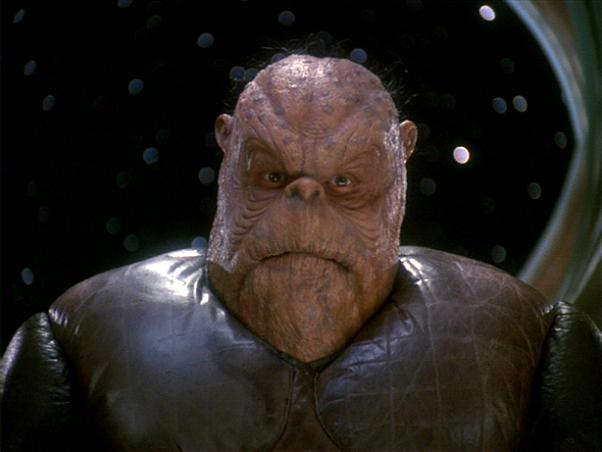
To this, I always reply by saying this picture: 
As you can see, the first and most important reason why Morn is Star Trek is because Morn is by far the handsomest and best-looking character to ever grace the Star Trek universe, period.  On Star Trek, Morn was always depicted as quite the ladies' man, and it's not hard to see why.  That nose!  Those whispy hairs!  Kirk?  Riker?  Step aside, gentlemen!

The second reason Morn is Star Trek is because of his second stomach.  Morn has a second stomach, and using Origen's principles of Biblical interpretation, we can say that this is obviously an allegory for the dual nature of Star Trek as both television and film, and also for the dual existence of Star Trek in both the minds and experiences of those who create it, and also in the hearts of the fans: it is this latter stomach, of course, that contains a massive supply of latinum currency, thus signifying the fact that it is the fans who provide the funds necessary to keep Star Trek alive, and also that feature films tend to be more profitable than television shows.  Likewise, the fact that this latinum has caused his hair to fall out signifies the way in which the influence of money and success has caused Star Trek as a whole to lose its original virility and freshness.  Morn's relationship with his hyper-capitalist bartender Quark, of course, and his consequent drinking habit, signify Star Trek's constant need for affirmation and (more importantly) material support from the studios, and Quark and Morn's generally-positive relationship signifies the studio's general esteem for the Star Trek franchise...so long as Morn pays his bar tab on time.  Morn's many squabbling siblings, of course, signify the many other sci-fi franchises and TV shows that have been inspired by Star Trek, and his difficult mother signifies the demanding sci-fi fanbase, for whose affection Morn and his siblings are forced to compete.  Like Morn, Star Trek is frequently said to be saying an awful lot of meaningful things, and yet somehow never actually manages to say much of anything onscreen.  In addition, Morn's quarters, which contain nothing but a mud-bath and a black velvet painting of a Matador, of course signify the two things that single-handedly keep the franchise going: the murky depths of popular culture, and William Shatner's toupee.

I could go on, but I think I've proved my point.  No other character in Star Trek other than Morn so completely encompasses Star Trek as a franchise.  The great thing, too, for all you English majors out there, is that there are multiple possible readings of Morn as an allegory!  There's the out-of-universe one that I've given, but also an in-universe reading, a cosmological reading (where Morn's appearance, properly interpreted, gives a rough map of the Star Trek universe), a mystical reading, a socio-political reading, an anarcho-feminist reading, a fascist-Rastifarian reading, and of course the ever-popular Swedenborgian Reading of Morn, best exemplified by Professor Bosh's magnum opus The Illusiveness of Eschatology in Lurian Psycho-Physical Sociology: The Swedenborgian Reading of Morn.

Alright, I think that is enough foolery for the moment. The real reason that Morn is Star Trek is far more mundane, and far more interesting.  See, the thing is, Morn was not supposed to be a Star Trek character.  He started his existence, in fact, as one of dozens of masks created by the makeup crew to serve as background extras for the very first episode of Star Trek: Deep Space Nine.  Morn was never supposed to be a character at all; he was just one mask among many, designed to be shoved onto an extra and shoved into the far background of one shot, and then at some later point, probably half a season later, be again shoved onto a completely different extra and shoved into the back of another shot.  Instead, of course, Morn ultimately became the stud of a character you see today.  What happened?

In short, Star Trek happened.  First, enter Mark Allen Shepherd, an actor happening to attend a massive casting call, and then happening, by chance and head size, to be picked to inhabit the then-nameless suit and appliance.  Then, by an even greater coincidence, Shepherd ended up accidentally getting left off the call sheet, and, by an even more astronomical and uncanny chance, decided to wander onto the set to see what was going on at the exact day and time when Morn was supposed to appear.  Then, when the shot was ready, by another coincidence, he got picked out of the crowd of hundreds of extras by the director and put in the foreground of an establishing shot.  Then, Shepherd successfully performed in the suit in such a way that the executive producers noticed him among all the other extras, and hired him for other episodes.  Then, as the series continued, Shepherd was hired again and again, appearing at Quark's bar practically every single time the set was used, and becoming a constant presence on the show.  Then, the unknown alien began to be mentioned in dialogue and in scripts, had main characters talk about him, interact with him, and even give him a name and a species.  Thus, in practically the blink of an eye, that random mask and suit became Morn, a full-fledged character and a living, breathing part of Deep Space Nine and Star Trek.  Over the course of the full seven years of Deep Space Nine (the kind of series run that only very successful shows and Star Trek series get), Morn was talked about, developed, and ended up becoming, in places, a key part of the plot of episodes and the show as a whole, even getting an entire episode about him...all without uttering a single word onscreen.  We learn about Morn's demanding mother, his squabbling siblings, his second stomach, his lost hair, his criminal past, his shipping business, his weekly sparring matches with Worf in the holodeck, his popularity with the ladies, and a hundred, thousand other things.

Through all of this, Morn is, in reality, nothing more than a few pounds of latex and rubber on an actor, sitting silently at the bar, listening to Quark talk, or walking around the station...essentially, doing pretty much nothing...and yet, in the world of the show and in the minds of its viewers, he is a living, breathing, talkative, charming, amusing person, with friends, family, and a life of his own...who also happens to be a hideous alien with two stomachs.

This is, frankly, the kind of thing that could only happen on a television show, on that week-in, week-out grind of episodes, year after year, where characters can be built up out of nothing, elaborated on, talked about, and developed in a way that is simply impossible to do in feature films...and it is also, frankly, the kind of thing that could only happen on Star Trek, in that strange world where the hideous aliens that populate the background of shots not only aren't just vicious cannon fodder to be gunned down by the hundreds, but are expected as a matter of course to be thinking, vital people with lives and problems of their own, where (to quote Nick Meyer) even the aliens are human, where the audience is invited to buy into a setting and suspend their disbelief to an extent undreamed of in most fiction, where characters and situations can be taken to absurd and whimsical lengths that would never, in a thousand years, fly in any Earth-bound show, where writers and producers have (or at least had) the opportunity to have fun and let their imaginations run wild without constantly worrying about being cancelled or not appealing to the right demographics, and where (in short) the background of the world has the potential to be as rich and varied as the foreground.  There are many other characters and situations that exemplify these things as well, but for me at least, none of them do so in so obvious and so handsome a fashion as Morn.

 Morn, with his trademark onscreen silence and off-screen talkativeness, is certainly a comic character, with a number of running jokes associated with him; but, as I've shown, in the world of the show and in the mind of its viewers he is ultimately much, much more: a living, breathing character exemplifying all that Star Trek can be.

Having said all that, I will now invite you to watch Morn in action, in a scene that he doesn't even appear in no less!

And that, my dear hypothetical, is why I am a Star Trek fan.